


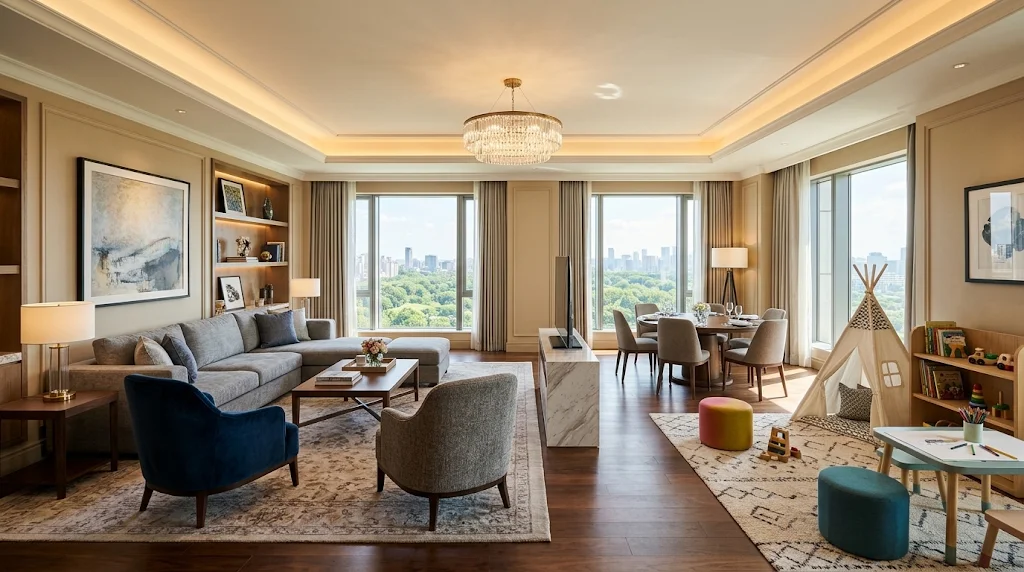
Family suite hotel furniture is specified for a guest mix that no other room type has to serve: two adults, two or three children, and often a grandparent, all in one suite for several nights. The demands pull in opposite directions. Parents want the suite to look like a design hotel; children treat every surface as a climbing frame; grandparents need a bed that is easy to get in and out of and a bathroom they can reach safely. After more than 25 years manufacturing loose and fixed furniture for five-star hotels and serviced residences, we have learned that family suites fail not because the pieces are badly made, but because the specification was written for a photograph rather than for four people living in one room.
The commercial case is strong. Family travel has grown faster than most other segments, and a well-designed family suite commands a premium while holding occupancy across school holidays. But the same suite is also the room most likely to generate maintenance tickets, damage claims, and safety incidents. This guide sets out how to specify family suite hotel furniture so the room is safe, durable, and genuinely comfortable for multiple generations — without looking like a nursery.
Start with the people, not the layout
Before any furniture is selected, define the actual occupancy scenarios. A family of four with toddlers behaves differently from a family with two teenagers, and both behave differently from a multi-generational group where a grandparent needs a bed close to the bathroom. The furniture plan should be tested against at least three scenarios, because the same suite will rotate through all of them within a year.
We map each scenario against four needs: sleep, storage, movement, and supervision. Sleep is about bed count and bed type; storage is about where four people put their luggage and clothes; movement is about clear paths at night; supervision is about whether a parent can see the children from the living area. When those four are resolved, the furniture selection becomes much less arbitrary.
Safety is a specification item, not a warning card
Family suites carry a higher safety burden than standard rooms, and most of it sits in the furniture. Tall casegoods must be anchored to the wall, not simply placed against it. Bunk beds need guard rails on the upper level and a ladder that is fixed, not hooked. Coffee tables and bedside tables should have rounded edges or a radius large enough that a fall does not produce a sharp contact point.
- Anchor every tall piece — wardrobes, dressers, and shelving must be mechanically fixed to the wall structure, with the fixing method documented.
- Guard the upper bunk on all open sides, with a rail height that suits the age group the suite is marketed to.
- Avoid glass tops at low level and specify tempered glass where glass is required.
- Round the corners on all low tables and any piece at child height.
- Check the gaps between bunk rails and mattress, and between furniture and wall, against the relevant safety guidance for the market.
These are not expensive additions when they are designed in. They become expensive when they are retrofitted after an incident, or when a brand audit finds an unanchored wardrobe in a suite that was signed off months earlier.
Sleeping arrangements that flex without looking temporary
The hardest brief in a family suite is the second sleeping zone. A sofa bed is the common answer, but a cheap mechanism turns the living room into a nightly construction project and generates complaints from the third night onward. A purpose-built sofa bed with a proper mattress and a smooth mechanism costs more at specification but is the difference between a suite that sells and one that is reviewed as "fine for one night".
Where space allows, a built-in bunk niche is often the better solution: two beds in the footprint of a wardrobe, with storage drawers underneath and a curtain for privacy. It reads as designed rather than improvised, and children prefer it. For multi-generational stays, a daybed or a convertible bench in the living area gives a third sleeping option without adding another visible bed.
Whatever the arrangement, specify the mattress and the mechanism to the same standard as the main bed. The guest who sleeps badly in a family suite does not blame the sofa; they blame the hotel.
Storage for four people in a two-person footprint
Family suites typically hold two to three times the luggage of a standard room, and the storage is designed for half of it. The result is suitcases on the floor, clothes on chairs, and a room that never looks tidy no matter how often housekeeping visits.
The fix is to plan storage by volume rather than by piece count. A wardrobe with full-height hanging, a dresser with deep drawers, and a luggage bench that doubles as a seat will usually outperform three small cabinets. Under-bunk drawers are the most efficient storage in the room because they use space that would otherwise be dead. A visible shelf for children's belongings also reduces the tendency to use every surface as a shelf.
One practical detail: specify drawer runners and hinges for the way children use them. A drawer that is pulled open and used as a step will fail if the runner is residential grade. Hospitality-grade hardware and a stop that prevents full removal are worth the small uplift. When you review hotel guestroom furniture sets, ask how the casegoods are specified for family use rather than adult-only occupancy.
Surfaces that survive sticky hands and cleaning chemicals
Family suites are cleaned more aggressively than standard rooms, and the surfaces take juice, snacks, sunscreen, and craft glue. A finish that is beautiful but porous will stain within a season; a finish that is too matte will show every wipe mark. The right answer is usually a commercial-grade finish with a moderate sheen, tested against the cleaning agents the property actually uses.
Fabric follows the same logic. Light colors photograph well but show every mark; a tightly woven, solution-dyed fabric in a mid-tone hides wear and cleans more easily. Where a lighter palette is required by the brand, specify a performance backing and a cleaning code that matches the housekeeping chemicals — otherwise the first spill becomes a permanent shadow.
The bathroom edge and the outdoor threshold
Furniture near the bathroom and the balcony takes the most moisture in the suite. A vanity stool, a towel bench, or a balcony chair made from a material that swells or corrodes will fail early. Specify moisture-resistant substrates and stainless or coated hardware in these positions, and check that the finish is rated for wet-area cleaning.
If the suite has a balcony or terrace, the outdoor pieces should be specified as outdoor furniture even if they look indoor. UV stability, drainage, and salt-air resistance are different requirements from interior durability, and a residential outdoor chair will not survive a coastal property's season.
A specification checklist for family suite hotel furniture
| Area | What to specify |
|---|---|
| Tall casegoods | Wall anchoring, drawer stops, hospitality-grade runners |
| Bunk beds | Guard rails, fixed ladder, gap control, under-bed storage |
| Sofa bed | Hospitality mechanism, proper mattress, smooth operation |
| Low tables | Rounded edges, no low glass, stable base |
| Upholstery | Contract cleanability, fire certification, mid-tone durability |
| Wet and outdoor edges | Moisture-resistant substrate, UV and corrosion resistance |
Frequently asked questions
Should family suites use bunk beds or sofa beds?
Both have a place. Bunks suit younger children and use vertical space efficiently; a good sofa bed keeps the living area flexible for multi-generational groups. The mistake is a cheap mechanism in either.
How do we keep the room from looking like a nursery?
By keeping the palette and materials consistent with the rest of the hotel, and hiding the child-specific functions inside designed pieces — under-bunk drawers, a bench that opens, a niche behind a curtain.
What safety standards apply to family suite furniture?
They vary by market. The consistent requirements are wall anchoring for tall pieces, guard rails on upper bunks, rounded edges at child height, and tempered glass where glass is used. Confirm the local guidance with your consultant.
Is family suite furniture more expensive?
Slightly, because of anchoring, better hardware, and dual-purpose pieces. The difference is small against the cost of damage, complaints, and early replacement in the room type that takes the most abuse.
Can the suite convert back to a standard room later?
Yes, if the bunk or sofa bed is designed as a modular piece rather than a built-in structure. Planning for that flexibility at specification stage avoids a full refit if the market shifts.
Family suite hotel furniture is a small room with a large brief. Get the safety details right, plan storage by volume, specify the second bed to the same standard as the first, and choose finishes that survive sticky hands. The suite then earns its premium without becoming the property's most expensive room to maintain.
Why global hospitality teams work with OC International
OC International (OCI) has manufactured loose and fixed furniture for five-star hotels, resorts, and serviced residences since 1997. From our manufacturing base in Dongguan we support owners, developers, design firms, and FF&E consultants across the Americas, the Middle East, and Asia with one accountable team covering design development, production, quality control, packing, shipping, and on-site installation.
What our manufacturing base delivers
- In-house casegoods, soft seating, millwork and joinery under one roof — one specification, one documented quality system, one point of accountability.
- Builds engineered to the fire-safety and emissions standards your market requires — CAL 117, CAL 133, TB 133, EN 1021, BS 5852, FSC timber, and CARB P2 — under an ISO 9001-controlled production process.
- Custom joinery for bunks, niches, and dual-purpose pieces, engineered as furniture rather than adapted millwork.
- Coordinated logistics and installation that keep multi-room-type properties on a defined delivery sequence and a protected opening date.
Selected delivered projects
Our furniture has been delivered to landmark properties including the Fairmont Austin, Four Seasons Chicago, Sheraton Dhaka, Marriott Sydney, Conrad Los Angeles, and Hilton DoubleTree projects across multiple regions — each specified to the operator's brand standard and installed to opening.
Family suite hotel furniture has to work for a toddler, a teenager, and a grandparent in the same week — send us your suite plan and we will engineer around it.
Review guestroom furniture sets Share your family suite layoutYour email address will not be published. Required fields are marked *