


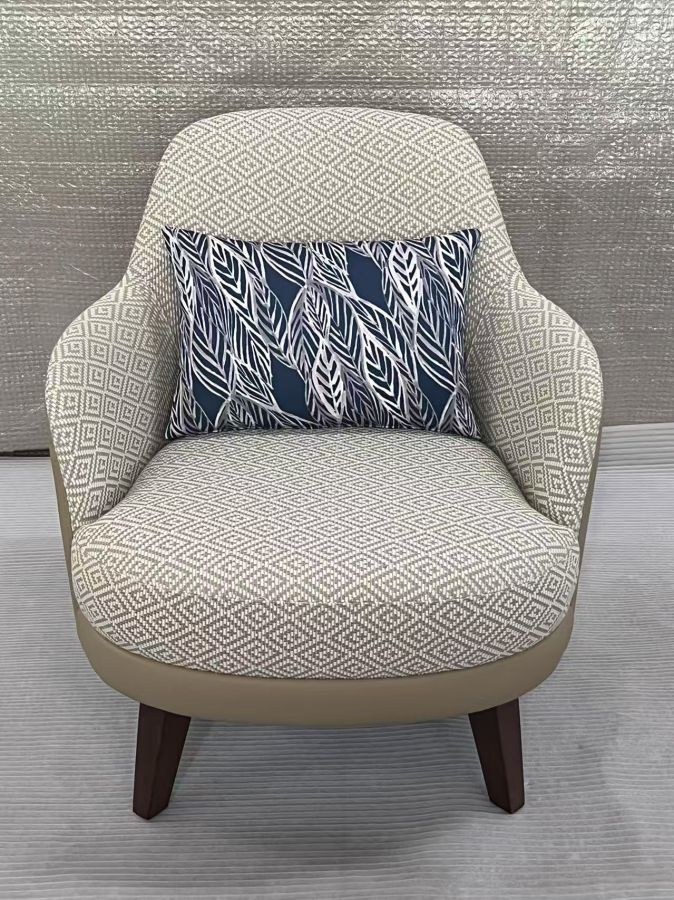
High end hospitality furniture is a perception problem before it is a cost problem. Guests do not know what a piece cost, and they do not care. They register weight, alignment, texture, sound, and whether the room feels considered. Two schemes at very different budgets can produce the same impression, and two schemes at the same budget can produce very different ones, because the money is spent in different places.
We have built furniture for five-star hotels and resorts since 1997, and the most effective premium schemes we have supplied were not the most expensive per piece. They were the ones where the specification concentrated spend on the few details a guest actually contacts. This guide sets out those levers, and the ones that look impressive in a sample but disappear in service.
The four signals guests register
Perceived quality in hospitality furniture comes down to four signals, and all four are engineering rather than decoration.
Weight and solidity. A drawer that moves with resistance and closes with a soft thud reads as quality; a light, rattling box reads as flat-pack. Mass comes from the carcase, the drawer box, and the runner, not from the front panel.
Alignment. Even reveals, flush fronts, and consistent gaps across a run of casegoods are the clearest evidence of a controlled factory. Guests may not measure a two-millimetre gap, but they see a wall that looks orderly.
Touch. The feel of an edge, the warmth of a timber top, the grain of a leather. Texture is where high end hospitality furniture earns its impression, and it is also where cheap substitutes are most obvious.
Sound. A chair that scrapes, a door that bangs, a table that rings. Quiet furniture is expensive to engineer and almost free to notice.
Where premium spend returns the most
| Lever | Perceived gain | Service impact |
|---|---|---|
| Undermount soft-close runners | High — the most-used mechanism in the room | Fewer alignment complaints over time |
| Thicker edge and radiused profile | Medium — felt at the wrist and seen at the corner | Fewer chips, longer life |
| Higher-density seat foam | High — the first thing a guest feels when sitting | Retains shape; fewer replacements |
| Finish build and cure control | Medium — depth of sheen and a dry, even surface | Resists marking; can be repaired |
| Glides matched to the floor | Low individually, high in aggregate — the room sounds calmer | Less floor damage, less noise complaint |
| Decorative inlay and marquetry | Low in service — noticed once, at close range | Difficult to repair, no durability gain |
Value engineering without a visible loss
Almost every high end hospitality furniture scheme is value-engineered at some point. The mistake is to cut where the guest will feel it. The right sequence is to reduce what nobody contacts first: simplify a hidden back panel, standardise a fixing, reduce the number of unique pieces, or consolidate the finish palette.
Consolidating finishes is often the largest saving available and the least visible. A scheme with six timber tones and four metal finishes requires more setup, more samples, and more chance of a mismatch. Reducing to two timber tones and two metals usually improves coherence as well as cost.
What should not be cut: runner quality, seat foam density, edge protection, and the finish on surfaces that hands touch. Those four account for most of the perceived quality and most of the maintenance cost, and reducing them converts a one-time saving into a recurring expense.
Consistency is a premium signal
A room where every piece looks like it came from the same workshop reads as high end; a room where the nightstand and the desk disagree on timber tone, sheen, and edge treatment reads as assembled. Consistency across a project is a specification decision, not a manufacturing one, and it is achieved by holding one finish reference across all pieces and by making the supplier responsible for the match between its own items.
This is a strong argument for buying the visible pieces of a room from one source. When casegoods, headboard, and seating come from separate factories, the finish match becomes the owner's problem, and the difference is usually discovered on site.
The prototype is where premium is proven
A high end scheme should always be approved through a physical prototype, reviewed under the property's own lighting. Sample books and renders cannot show how a veneer catches light at an angle, or how a fabric reads next to a stone top. The prototype is also the moment to test the mechanism: open the drawer fifty times, sit in the chair for an hour, listen to the room.
Sign the prototype, photograph it, and keep it. It becomes the production standard, the reference for any dispute, and the benchmark for a refurbishment five years later.
Public areas set the price expectation
A guest forms a view of the property within the first minute, in the lobby, before reaching the room. That makes public area furniture disproportionately important to perceived quality, and it is where high end hospitality furniture earns the most attention per unit.
The lobby lounge is also the hardest position in the building. It receives the most traffic, the least supervision, and the widest range of use: a guest waiting with a case, a meeting over coffee, a child climbing on an armchair. Premium materials here need robust engineering behind them, which is why a lobby chair at a high end property is usually built heavier than its appearance suggests.
Look at the details guests touch while waiting: the armrest, the seat edge, the table edge, the underside of a stool. These surfaces receive repeated contact and are the first to show wear. Specifying a solid lipping on a table edge or a wrapped seat edge on a chair costs little and extends the period before the piece looks tired.
Where the budget is finite, it is usually better to concentrate on fewer, better public area pieces than to spread the same money across a larger quantity. A lobby with six excellent chairs and generous spacing reads more expensive than one with twelve ordinary chairs arranged tightly.
The same principle applies to suites. A suite is judged against a higher expectation than a standard room, and the pieces that create the impression are usually the seating and the table, not the additional joinery. Spend there, and the suite reads as a different category rather than a larger version of the room next door.
It also helps to keep one signature piece per space and let the rest support it. A single well-engineered lounge chair, a substantial table, or a beautifully finished desk gives the room a centre; a room of equally assertive pieces reads as a furniture showroom instead.
Frequently asked questions
Does high end mean bespoke for every piece?
No. A standard piece with a custom finish and specified hardware often delivers a more coherent result than a bespoke item built without hotel experience.
Where is the worst place to economise?
On the parts a guest touches and operates: runners, hinges, seat foam, and the finish on tops and drawer fronts. The saving is small and the visibility is high.
How do we keep a premium feel in public areas?
Use robust materials with premium detailing rather than delicate materials: heavier frames, tighter tolerances, better upholstery, and surfaces that can be repaired.
Is a lighter colour scheme riskier in service?
It shows soiling sooner, so it needs a higher performance tier and a faster cleaning routine. If the design calls for pale, spend the difference on cleanability.
How many finishes should a scheme use?
As few as the design can carry. Each additional finish adds setup cost, sample rounds, and a chance of mismatch between production batches.
High end hospitality furniture is produced by concentrating spend where the guest makes contact and by holding consistency everywhere else. Do that, and the room reads as premium without the specification having to be extravagant.
Why global hospitality teams work with OC International
OC International (OCI) has manufactured loose and fixed furniture for five-star hotels, resorts, and serviced residences since 1997. From our manufacturing base in Dongguan we support owners, developers, design firms, and FF&E consultants across the Americas, the Middle East, and Asia with one accountable team covering design development, production, quality control, packing, shipping, and on-site installation.
What our manufacturing base delivers
- One finish reference held across casegoods, headboards, and seating produced in-house, so a room reads as one scheme.
- Builds engineered to CAL 117, CAL 133, TB 133, EN 1021, BS 5852, FSC timber, and CARB P2 under an ISO 9001-controlled production process.
- Value engineering proposals that identify what can be reduced without touching the surfaces guests feel.
- Prototype review under project lighting, with the signed piece retained as the production standard.
Selected delivered projects
Our furniture has been delivered to landmark properties including the Fairmont Austin, Four Seasons Chicago, Sheraton Dhaka, Marriott Sydney, Conrad Los Angeles, and Hilton DoubleTree projects across multiple regions, each specified to the operator's brand standard and installed to opening.
Working to a premium brief and comparing high end hospitality furniture suppliers? Send the specification and we will show where the spend is visible and where it is not.
See public area sets Request a value reviewYour email address will not be published. Required fields are marked *