


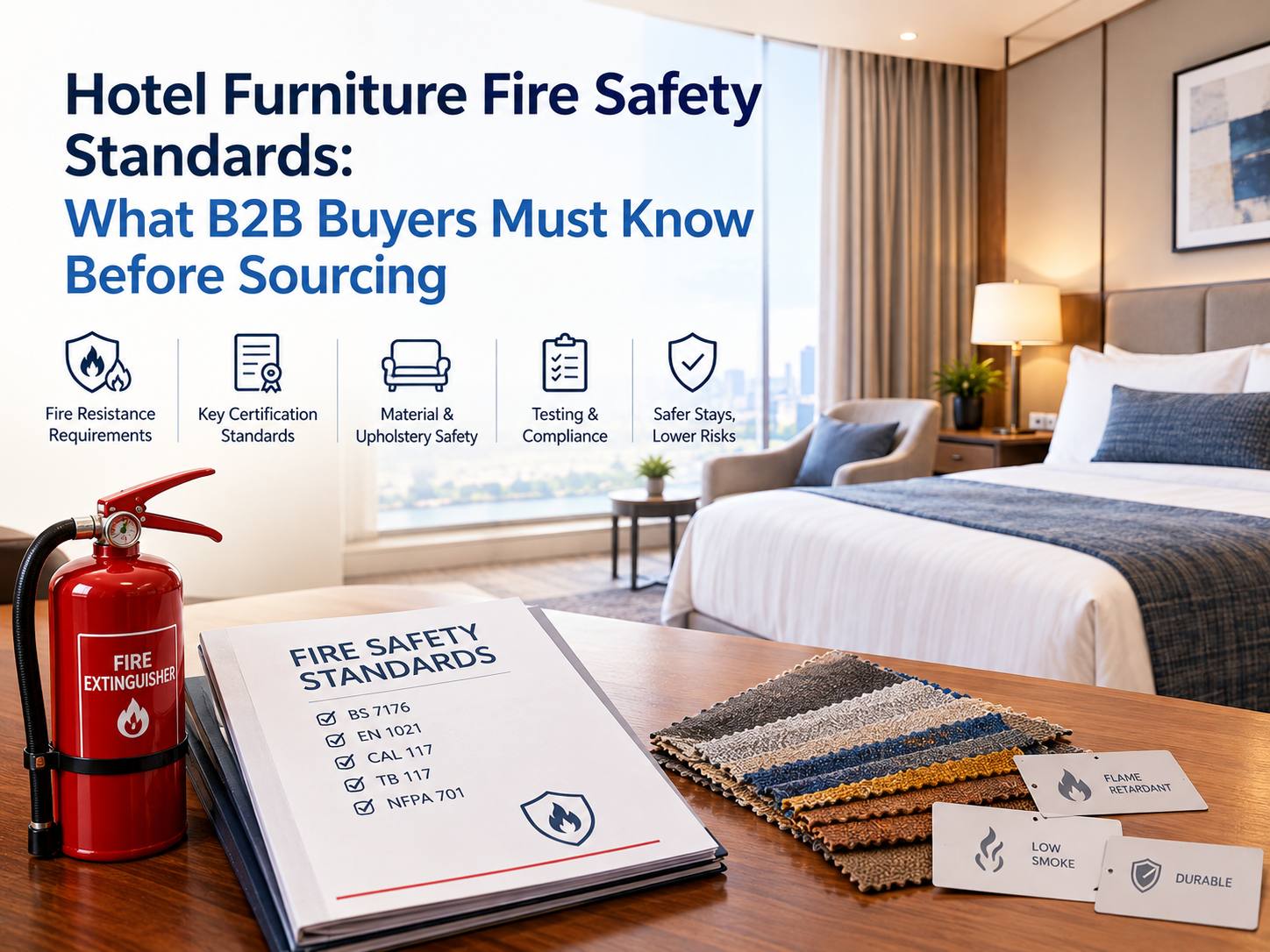
Hotel furniture fire safety standards are not a finishing touch — they are a procurement requirement that decides whether a shipment clears customs, whether a room passes inspection, and whether an operator accepts the delivery at all. Specify them late and you either rework the build or watch a container sit at port. After more than 25 years manufacturing loose and fixed furniture for five-star hotels, resorts, and serviced apartments, we treat fire compliance as a build parameter set at the design stage, not a certificate chased after production.
What hotel furniture fire safety standards actually cover
In hospitality, fire safety is governed by a stack of standards that vary by market but share the same intent: slow ignition, limit smoke, and protect escape time. For upholstered pieces, the relevant tests measure the combustion behavior of the foam, the fabric, and the composite build-up. For casegoods and fixed joinery, the concern shifts to surface spread of flame and the emissions of panel adhesives and finishes. A credible manufacturer engineers to the standard your market names — CAL 117 and CAL 133 in California, TB 133 for high-occupancy public spaces, EN 1021 across much of Europe, and BS 5852 in the United Kingdom — rather than hoping a generic build passes.
The reason hotel furniture fire safety standards deserve attention before a quote is requested is simple: the compliant version and the non-compliant version look identical on a render and can differ sharply on cost and lead time. A buyer who compares two quotes without confirming the fire build-up is often comparing one compliant package against one that would fail inspection.
The standards buyers most often encounter
| Standard | Where it applies | What it governs |
|---|---|---|
| CAL 117 | California, widely referenced in the US | Smolder resistance of upholstered filling materials |
| CAL 133 / TB 133 | California public spaces, high-occupancy rooms | Full-furniture open-flame performance for seating |
| EN 1021 | European Union | Cigarette and match resistance of upholstery |
| BS 5852 | United Kingdom | Source-based ignition of upholstered composites |
Build the compliance into the specification, not the paperwork
The most common failure we see is a specification that mentions "fire retardant" as a single line item while the fire-safety build-up of every upholstered element is left undefined. Hotel furniture fire safety standards are met at the material level: the foam grade, the interliner, the fabric face, and the way they are assembled. State each layer in the spec and require the supplier to document it. A documented build-up also protects you if a brand auditor or local inspector asks for evidence after installation.
For fixed furniture and millwork, compliance is quieter but real: panel emissions, edge banding adhesives, and surface finishes all contribute to indoor air quality and fire performance. Specifying CARB P2 or equivalent low-emission panels and a documented finish system keeps a project aligned with both fire and occupancy requirements.
A short compliance checklist for buyers
- Name the exact standard your market and brand require — do not leave it to the supplier's assumption.
- Require a documented foam-and-fabric build-up for every upholstered piece, not a generic "FR" note.
- Confirm panel emissions (CARB P2 / E0 / E1) for casegoods and joinery.
- Ask for the certificate pack alongside the production order, not after shipping.
Why source from a manufacturer that engineers to standard
When hotel furniture fire safety standards are treated as an engineering input, the whole project gets simpler. A manufacturer with in-house casegood, soft-seating, millwork, and joinery capability can hold one documented quality system across the entire package, so the upholstered banquette and the adjacent fixed panel meet the same compliance logic. OC International builds loose and fixed furniture to the fire-safety and emissions standards each market requires, under an ISO 9001-controlled process, and documents the build-up for audit.
Explore the scopes that most often carry fire-compliance requirements: casegood and soft seating sets, hotel public area furniture sets, and millwork and joinery give a clear picture of where compliance must be specified.
How fire testing actually works, and what the certificate proves
Fire testing is performed on a defined construction, not on a loose swatch. For upholstery, a recognized laboratory ignites the assembled seat — foam, interliner, and fabric together — and measures ignition, flame spread, and smoke under the named standard. The certificate that results describes that exact build-up. This is why hotel furniture fire safety standards cannot be satisfied by approving a fabric sample alone: the document proves a system, and if the production build-up differs from the tested one, the certificate no longer applies.
For this reason, the practical control is traceability. Keep the tested build-up on file, require the production order to name the same foam grade, interliner, and fabric, and ask the manufacturer for a certificate pack tied to those specific materials. A documented chain from test to production is what survives a brand audit or a local inspection months after delivery.
Mistakes that delay opening
The expensive fire-compliance mistakes are rarely about the furniture looking wrong — they are about paperwork arriving late or to the wrong standard. Three recur: specifying "FR" without naming the standard, so the factory defaults to the cheapest certificate that may not match the destination market; requesting the certificate only after shipping, when re-testing is no longer possible on the production run; and assuming one global certificate covers every property, when a brand operating across two regions may need two named standards. Each turns a routine clearance into a hold at port or a failed inspection.
Hotel furniture fire safety standards are easiest to honor when they are decided at the design stage and carried as a named requirement through prototype, production order, and certificate pack. The cost of doing so is a few lines in the spec; the cost of skipping them is a shipment that cannot be installed.
Specifying fire compliance in the purchase order
Fire compliance is easiest to enforce when it is written into the purchase order as a named requirement rather than left as a hope. The order should state the exact standard, the foam grade and interliner, the fabric face, and the certificate pack to be supplied with the shipment. Hotel furniture fire safety standards enforced this way become a measurable acceptance criterion: a piece arrives with the documentation, or it does not pass receiving. This shifts compliance from a post-delivery worry to a contracted deliverable, and it gives the operator and the brand auditor a clean paper trail.
The same discipline applies to fixed furniture and millwork, where panel emissions and finish systems must also be named. When the purchase order carries the full compliance requirement, the supplier is measured against it at every stage, and the furniture is ready to pass inspection rather than ready to be reworked after a failed check.
Frequently asked questions
Do fire standards change the look of the furniture?
No. A compliant foam-and-fabric build-up is invisible in the finished piece. The difference is in the materials specified, not in the silhouette or finish.
Can one build satisfy multiple markets?
Often yes, when the build-up is engineered to the strictest applicable standard. Confirm with the supplier which certificates the documented build actually carries.
Who provides the compliance certificate?
The manufacturer should supply the certificate pack tied to the specific materials used. Request it as a contract deliverable, not an afterthought.
Does a fire certificate expire?
The certificate describes a tested build-up; it stays valid as long as production uses that exact construction. The risk is drift — a substituted foam or fabric invalidates the document even when the swatch looks identical.
Can a non-compliant piece be retrofitted on site?
Rarely. Fire performance is built into the materials, so a non-compliant piece usually has to be rebuilt. Specifying correctly up front is far cheaper than correcting after delivery.
In short, hotel furniture fire safety standards are a design-stage decision, not a post-production fix. Name the standard, document the build-up, and source from a manufacturer that engineers to it — and the furniture arrives ready to pass inspection rather than ready to be reworked.
Why global hospitality teams work with OC International
OC International (OCI) has manufactured loose and fixed furniture for five-star hotels, resorts, and serviced residences since 1997. From our manufacturing base in Dongguan we support owners, developers, design firms, and FF&E consultants across the Americas, the Middle East, and Asia with one accountable team covering design development, production, quality control, packing, shipping, and on-site installation.
What our manufacturing base delivers
- In-house casegoods, soft seating, millwork and joinery under one roof — one specification, one documented quality system, one point of accountability.
- Builds engineered to the fire-safety and emissions standards your market requires — CAL 117, CAL 133, TB 133, EN 1021, BS 5852, FSC timber, and CARB P2 — under an ISO 9001-controlled production process.
- Prototype-to-volume discipline: a signed guestroom mock-up is the reference standard every production order is measured against.
- Coordinated logistics and installation that keep multi-room-type properties on a defined delivery sequence and a protected opening date.
Selected delivered projects
Our furniture has been delivered to landmark properties including the Fairmont Austin, Four Seasons Chicago, Sheraton Dhaka, Marriott Sydney, Conrad Los Angeles, and Hilton DoubleTree projects across multiple regions — each specified to the operator's brand standard and installed to opening.
Ready to specify furniture that passes inspection the first time?
Review fire-certified furniture scopes Talk to our compliance teamYour email address will not be published. Required fields are marked *