


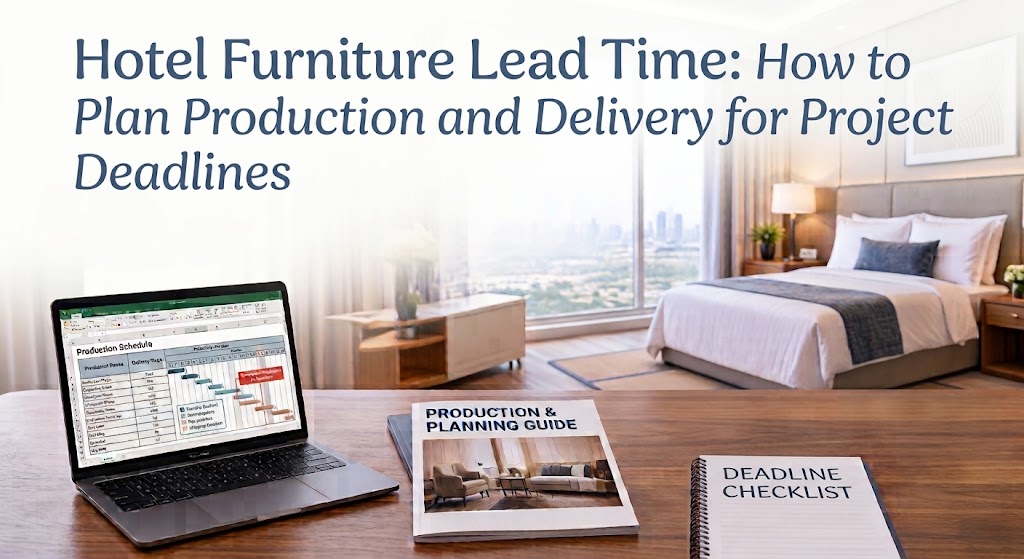
Hotel furniture lead time is the single variable that most often decides whether a property opens on schedule or opens with empty rooms. Unlike uniforms or amenities, furniture cannot be bought off a shelf in volume — it is built to spec, finished, packed, and shipped across an ocean. After more than 25 years supplying loose and fixed furniture to five-star hotels, resorts, and serviced apartments, we have seen lead time treated as a footnote one too many times, and the opening date pay for it.
What hotel furniture lead time actually includes
Lead time is not just "factory time." A realistic hotel furniture lead time runs from design sign-off through prototype, production booking, manufacturing, quality control, packing, ocean transit, customs clearance, and on-site installation. Skip any one of those in the plan and the date slips. The two longest and least compressible stages are brand design approval and the production slot itself — both must be booked in writing, not assumed.
The reason hotel furniture lead time deserves its own plan is that capacity is finite. A credible manufacturer commits a build window against a specific project; a vague "we can do it" with no slot is how a container quietly slides three weeks. Lock the window before you commit the opening date to the operator.
Build the schedule backward from opening
Start with the opening date and subtract the immovable legs — ocean transit, customs, and installation — first. What remains is the latest possible production start, and from there the latest possible prototype approval and design sign-off. This backward math turns lead time from a hope into a calendar with owners.
- Design development and brand sign-off — the longest, least predictable window.
- Prototype and sample approval — build one full room before mass production.
- Production slot booking — capacity is finite; secure it in writing.
- QC, crated packing, ocean freight, customs, and installation close-out.
Protect the window with a prototype, not a panic
The cheapest way to protect a lead time is a prototype approved on build quality, not just appearance. When the approved sample is documented and referenced in the production order, the factory is measured against the thing everyone signed off on — and rework during the build window shrinks. A prototype also de-risks the volume order so the production slot is not consumed by corrections.
Hotel furniture lead time also improves when scope is bundled. Consolidating loose furniture, casegoods, soft seating, and millwork into one coordinated package gives a single accountable party for the delivery window, instead of several vendors each defending their own slip. OC International delivers exactly this kind of coordinated package, holding the build window through one project team from Dongguan to the site.
What to ask a manufacturer about lead time
Before you commit, ask for the build window in writing and confirm what it excludes. A manufacturer with documented global delivery — such as OC International, producing loose and fixed furniture since 1997 — can state the window against your specific scope and market, and coordinate installation through a single team. Review the scopes that most affect the schedule: casegood and soft seating sets, millwork and joinery, and loose furniture sets.
A realistic phase-by-phase timeline
Hotel furniture lead time breaks into stages that each carry a typical range, though exact weeks depend on scope and market. Design development and brand sign-off often run the longest and stay the least predictable, because they depend on the operator's approval cycle more than the factory. Prototype build and approval typically follow, then the production slot is booked, then manufacturing, quality control, packing, ocean transit, customs, and installation. A plan that names a range for each leg — rather than a single optimistic number — is what survives contact with reality.
Treating the timeline as a chain also shows where float belongs. The production and transit legs are commitments you can book; the approval leg is the one to protect with early starts. Hotel furniture lead time planned this way makes the risky leg visible instead of hidden.
How to compress lead time without cutting corners
There are legitimate ways to shorten hotel furniture lead time, and there are shortcuts that simply move the delay downstream. The legitimate levers are: starting approvals early so the brand cycle runs in parallel with prototyping; booking the production slot before sign-off closes so the window is reserved; and bundling scope so one coordinated package replaces several sequential vendor lead times. None of these sacrifices quality — they remove idle waiting.
The shortcuts to avoid are skipping the prototype, which trades a cheap correction for an expensive one, and compressing the production slot by overloading the factory, which usually slips instead. OC International holds the build window through one project team so the schedule is managed as a single chain rather than several hoped-for dates.
What to do when the opening date moves
Opening dates slip; it is a fact of development. The question is whether the furniture plan absorbs the slip or amplifies it. A plan with float on the furniture path can shift the install window without rebooking production; a plan with no float turns a two-week slip into a missed ocean window and a panic air-freight order. Hotel furniture lead time is most resilient when the production slot is booked with a small buffer and the install sequence is the first thing re-planned, not the last.
When a slip is unavoidable, tell the manufacturer early. A build window held open is far cheaper than a slot lost and re-competed, and early notice lets the supplier protect both the rate and the capacity. The buyers who manage lead time well treat the date as a shared commitment with the factory, communicated the moment it changes rather than after the fact. That early signal is often the difference between a recovered schedule and a compromised opening.
It also helps to separate the immovable legs from the flexible ones in the plan. Ocean transit and customs clearance follow their own clock; the production slot and the install sequence are where a slip can be absorbed with notice. Knowing which levers move and which do not is what keeps a delayed opening from becoming a cancelled one.
Frequently asked questions
How far ahead should we book production?
Early enough that the build slot is secured before brand sign-off closes. Capacity is finite, and the slot — not the quote — is what protects your date.
Can air freight recover a missed ocean window?
It can, at a steep premium, but it is a recovery tactic, not a plan. Building the schedule with float on the furniture path is far cheaper than buying back time in the air.
Does bundling scope shorten lead time?
Not the factory time, but it removes the coordination gaps between vendors that usually cause the slips. One accountable supplier means one delivery window to manage.
What is the longest single stage?
Usually brand design approval, because it runs on the operator's cycle rather than the factory's. Starting it early is the single highest-leverage move in the whole schedule.
Can we shorten transit instead of production?
Ocean transit is largely fixed; air freight is faster but at a steep premium and with lower container capacity. The cheaper gain is protecting the production and approval legs so transit starts on time.
In short, hotel furniture lead time is planned, not hoped. Work backward from the opening date, book the production slot in writing, prove the build with a prototype, and bundle the scope under one accountable manufacturer — and the furniture arrives inside the window instead of after it.
Why global hospitality teams work with OC International
OC International (OCI) has manufactured loose and fixed furniture for five-star hotels, resorts, and serviced residences since 1997. From our manufacturing base in Dongguan we support owners, developers, design firms, and FF&E consultants across the Americas, the Middle East, and Asia with one accountable team covering design development, production, quality control, packing, shipping, and on-site installation.
What our manufacturing base delivers
- In-house casegoods, soft seating, millwork and joinery under one roof — one specification, one documented quality system, one point of accountability.
- Builds engineered to the fire-safety and emissions standards your market requires — CAL 117, CAL 133, TB 133, EN 1021, BS 5852, FSC timber, and CARB P2 — under an ISO 9001-controlled production process.
- Prototype-to-volume discipline: a signed guestroom mock-up is the reference standard every production order is measured against.
- Coordinated logistics and installation that keep multi-room-type properties on a defined delivery sequence and a protected opening date.
Selected delivered projects
Our furniture has been delivered to landmark properties including the Fairmont Austin, Four Seasons Chicago, Sheraton Dhaka, Marriott Sydney, Conrad Los Angeles, and Hilton DoubleTree projects across multiple regions — each specified to the operator's brand standard and installed to opening.
Ready to map furniture lead time against your opening date?
Check current production windows Send us your opening dateYour email address will not be published. Required fields are marked *