


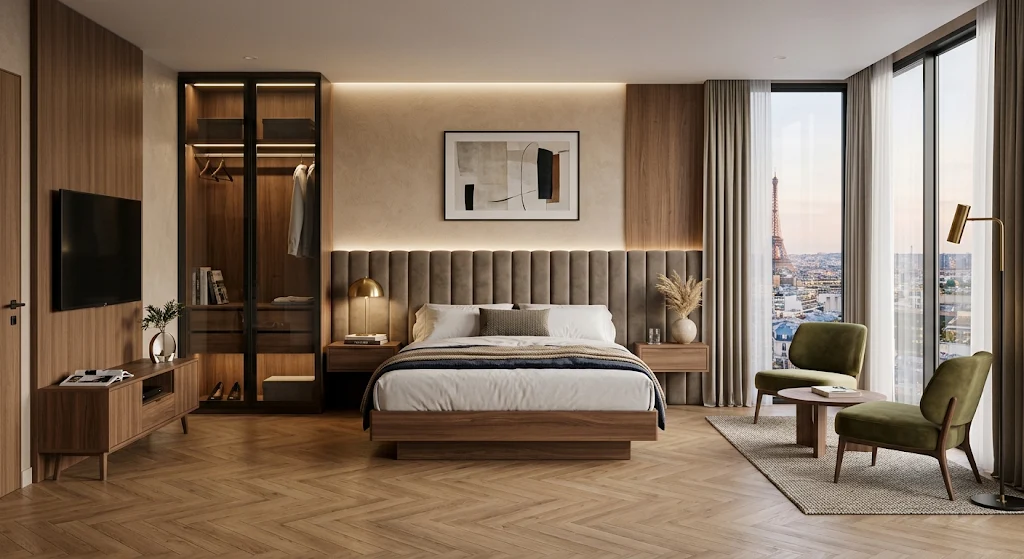
A turnkey hotel furniture solution is a single supply arrangement covering design development support, production, quality control, packing, shipping, and installation for the whole furniture package. Instead of coordinating a casegood factory, a soft-seating workshop, a millwork supplier, a freight forwarder, and an install crew, the owner contracts one party accountable for the outcome. On paper it looks like convenience. In practice it is a risk-allocation decision, and whether it is the right decision depends on the project, not on the supplier's sales pitch.
We build furniture for five-star hotels and resorts and have delivered both turnkey packages and piecemeal scopes. The pattern is consistent: turnkey wins where coordination is the dominant risk, and loses where the owner needs to keep certain scopes separate for commercial or design reasons. This guide sets out what a real turnkey hotel furniture solution includes, when one-stop supply is the better choice, and how to protect the project when it is.
What a turnkey solution actually includes
The word "turnkey" is used loosely, so the scope has to be written down. A genuine turnkey hotel furniture solution typically covers five layers: engineering the design into a buildable specification, prototyping and approval, volume production across all furniture categories, export packing and freight coordination, and on-site installation with snagging close-out.
It should also include the less visible work: compliance documentation for every material, finish matching across categories, spare parts, and a single delivery sequence that follows the construction programme. If any of those are excluded, the arrangement is not fully turnkey — it is a larger supply contract with the coordination still sitting with the owner.
When one-stop supply is the better choice
Turnkey supply earns its premium in projects where the interfaces between vendors are the main source of delay. That is most common in new-build hotels with a fixed opening date, multiple room types, and a design team working across several furniture categories.
- Opening-date pressure: when the date is fixed and penalties are real, one accountable delivery sequence removes the finger-pointing that costs weeks.
- Finish consistency: when casegoods, seating, and joinery must match in timber tone and sheen, one factory's finish line is easier to control than three suppliers' interpretations.
- Multi-room-type complexity: when a property has many room categories, a single production plan keeps the SKU count and the packing sequence coherent.
- Owner without a furniture team: when the owner has no in-house FF&E coordinator, buying coordination as part of the package is usually cheaper than hiring it.
- Remote project location: when the site is far from the factory and installation labour is scarce, a supplier that also installs removes a major unknown.
When it is not the right answer
Turnkey is not automatically better. There are situations where keeping scopes separate produces a stronger result: a signature restaurant where the design team has a long-standing specialist maker, a listed building where joinery must be restored by a conservation contractor, or a project where local content rules require part of the package to be sourced domestically.
It can also be the wrong choice when the owner has a capable FF&E team and strong vendor relationships. In that case, the coordination is already being done well, and the turnkey premium buys less. The honest question is not "is turnkey better?" but "where does coordination risk actually sit in this project?"
The coordination problem it solves
Fragmented supply creates a specific failure mode: each vendor delivers correctly against its own scope, and the project still fails at the interfaces. The casegoods arrive before the rooms are painted. The seating arrives after the install crew has left. The millwork is a half-shade different from the wardrobe because two factories bought timber from different lots. Nobody is at fault, and the owner absorbs the delay.
A turnkey hotel furniture solution collapses those interfaces into one plan. The factory that builds the casegoods also knows when the seating is scheduled, because it is building both. The install sequence is designed with the production sequence rather than negotiated afterwards. That is the real value: not a lower unit price, but fewer gaps between scopes.
Scope boundaries you must write down
Most turnkey disputes come from a boundary that was assumed rather than stated. The furniture supplier assumed the owner would handle customs clearance; the owner assumed the supplier would. The install crew assumed power and water would be available; the site was not ready. Each assumption is reasonable in isolation and expensive in combination.
A clear scope schedule should state, line by line, who is responsible for: design development and drawing approval, mock-up construction and approval, material compliance, export packing, freight and insurance, customs clearance and duties, delivery to site, storage before installation, installation labour, protection of finished floors and walls, snagging, and waste removal. Anything not assigned is a future argument.
Cost and schedule transparency
A one-stop supplier should be able to show the package as a landed-cost number with the major components visible: furniture, packing, freight, insurance, installation, and contingency. A single lump sum is convenient to approve and impossible to manage. When something changes — a room type is added, a finish is substituted — a transparent structure lets both sides price the change quickly instead of renegotiating the whole contract.
The schedule should be equally explicit. Ask for a production slot per category, a packing and loading plan, and an installation sequence by floor or room block. The sequence matters as much as the dates: furniture that arrives in the right order installs in days, while the same furniture arriving in the wrong order sits in a corridor blocking other trades.
A decision checklist
| Question | If yes, lean turnkey |
|---|---|
| Is the opening date fixed with penalties? | One accountable delivery sequence reduces schedule risk |
| Are there many room types and categories? | One production plan keeps SKUs and packing coherent |
| Must finishes match across casegoods and joinery? | One finish line is easier to control than several suppliers |
| Does the owner lack an in-house FF&E coordinator? | Buying coordination inside the package is usually cheaper |
| Is installation labour scarce or remote? | Supplier-led installation removes a major unknown |
| Is there a specialist maker the design depends on? | Then keep that scope separate and turnkey the rest |
Frequently asked questions
Is a turnkey hotel furniture solution more expensive?
The unit price may be slightly higher, but the delivered cost often is not, because duplicated freight, site delays, and coordination overhead disappear. Compare landed cost, not per-piece price.
Does turnkey mean we lose control of the design?
No. The design intent remains the owner's and the designer's. Turnkey shifts the engineering, production, and coordination responsibility, not the design authority.
Can we use our own freight forwarder?
Usually yes, if it is agreed at contract stage. Keep the responsibility clear: whoever books the freight should also own the documentation and the delivery window.
What if the project changes after the contract is signed?
A transparent cost structure makes change orders fast. Agree in advance how additions, deletions, and finish substitutions are priced, so a change does not reopen the whole contract.
How early should a turnkey supplier be appointed?
Ideally during design development, so engineering and compliance input can shape the specification before it is frozen. Appointing after the drawings are complete removes much of the value.
A turnkey hotel furniture solution is not a shortcut; it is a deliberate transfer of coordination risk. Choose it when the interfaces between vendors are the real threat to the opening date, write the scope boundaries down, and insist on landed-cost and production-slot transparency. Chosen for the right reasons, one-stop supply protects the schedule. Chosen as a slogan, it simply moves the argument later.
Why global hospitality teams work with OC International
OC International (OCI) has manufactured loose and fixed furniture for five-star hotels, resorts, and serviced residences since 1997. From our manufacturing base in Dongguan we support owners, developers, design firms, and FF&E consultants across the Americas, the Middle East, and Asia with one accountable team covering design development, production, quality control, packing, shipping, and on-site installation.
What our manufacturing base delivers
- In-house casegoods, soft seating, millwork and joinery under one roof — one specification, one documented quality system, one point of accountability.
- Builds engineered to the fire-safety and emissions standards your market requires — CAL 117, CAL 133, TB 133, EN 1021, BS 5852, FSC timber, and CARB P2 — under an ISO 9001-controlled production process.
- Single delivery sequences and installation planning built around the construction programme, not around the factory's convenience.
- A landed-cost structure with packing, freight, and installation visible as separate lines.
Selected delivered projects
Our furniture has been delivered to landmark properties including the Fairmont Austin, Four Seasons Chicago, Sheraton Dhaka, Marriott Sydney, Conrad Los Angeles, and Hilton DoubleTree projects across multiple regions — each specified to the operator's brand standard and installed to opening.
Weighing a turnkey hotel furniture solution against a multi-vendor package? Send us the scope schedule and we will map the interfaces.
See apartment and villa sets Book a scope reviewYour email address will not be published. Required fields are marked *