


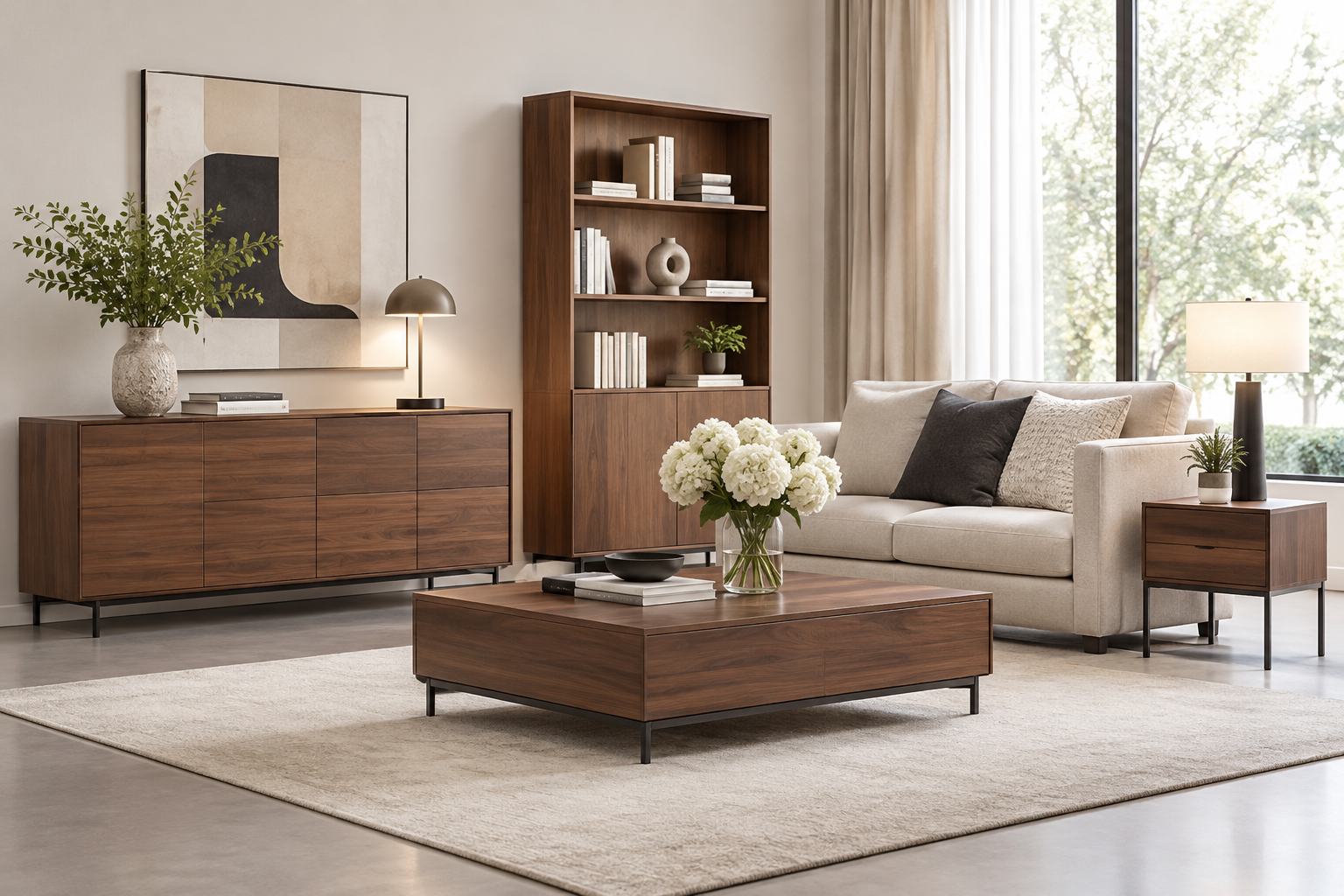
Casegoods furniture manufacturers build the hard furniture of a hotel: wardrobes, desks, nightstands, dressers, credenzas, and the built-in cabinetry that defines a guestroom. Unlike upholstery or loose seating, casegoods carry the brand standard in their lines, their joints, and their finish. A millimeter of misalignment or a half-shade of finish drift is immediately visible in a photograph, and the brand will see it. After more than 25 years manufacturing casegoods for five-star hotels, we know that vetting a casegoods manufacturer is less about showroom samples and more about process, engineering, and evidence.
This guide sets out what to examine before awarding a casegoods contract: the five capability dimensions that matter, the floor signals that separate a system from a workshop, the compliance documents that must be tied to your order, and the capacity questions that decide whether the schedule is real.
What casegoods manufacturers actually do
A casegoods factory is judged on four production capabilities: panel processing, edge banding, veneer or laminate pressing, and finishing. Each has a tolerance, and the tolerance is what the guest sees. A wardrobe door that sits proud by a couple of millimeters, a drawer front that does not align with its neighbor, or a sheen that varies between units — these are not cosmetic quibbles in a five-star room; they are the difference between a brand-standard fit-out and a near-miss.
Casegoods manufacturers also carry the engineering burden. Hotel drawings often specify a look that must be translated into a buildable construction: a floating nightstand needs hidden support; a long desk needs a substrate that will not sag; a tall wardrobe needs anchoring and door hardware that stays aligned after years of use. The factory's ability to resolve those details before production is as important as its machines.
The five dimensions to vet
- Engineering: can the factory read a designer's intent, propose a construction, and flag conflicts before production? Ask for a marked-up drawing from a past project.
- Panel and edge quality: how are boards cut, banded, and sealed? Edge banding is where moisture and impact damage begin, and where cheap construction shows first.
- Finish control: is finishing done in-house, under what environment, and how is colour matched between batches? A dedicated finishing line is a strong signal.
- Hardware and assembly: are runners, hinges, and connectors hospitality grade, and is the assembly checked for alignment and operation before packing?
- Documentation: can the factory evidence compliance and inspection per order, or does it rely on general certificates?
A factory strong on machines but weak on documentation will pass the showroom test and fail the audit. A factory strong on documentation but weak on finishing will pass the audit and fail the guest. The contract should go to the one that holds both.
Floor signals that separate a system from a workshop
Walk the production floor and look for organisation rather than scale. Board and veneer stored flat and dry, hardware segregated and labelled, work-in-progress identified by project, and a defined inspection area before packing. These are the visible signs of a documented process. A floor that looks busy but cannot tell you which project a stack belongs to is a floor where quality depends on memory.
Ask to see a piece in production for another client, with the drawing and the inspection record next to it. A factory that can connect drawing, build, and check is running a system. A factory that can only show finished pieces is showing a portfolio.
Also ask what is subcontracted. Veneer pressing, polishing, or upholstery may be outsourced, and that is acceptable if declared — but it changes the quality control and the lead time. Undeclared subcontracting is the single most common reason a factory's promise and its delivery diverge.
Compliance evidence that survives an audit
Casegoods compliance is mostly about board emissions and timber legality, with fire performance applying to any upholstered or composite elements. The evidence must match the actual materials used on your order: CARB P2 or the relevant emissions class for boards, FSC or equivalent for timber, and fire certification for any upholstered component.
A certificate for "similar" material is not evidence. Ask the factory to show how it links a material batch to a certificate and to your purchase order. If that link cannot be demonstrated, the document will not survive a brand audit or a customs query.
Capacity, slot, and the schedule you can hold them to
Casegoods are produced in batches, and the batch schedule is the real lead time. Ask what else is running during your window, and require a written production slot rather than an estimate. The slot should state when materials are reserved, when production starts, and when the goods are ready for packing.
A useful question is how the factory sequences multiple room types. A property with several room categories needs a production plan that keeps the SKUs organised and the packing sequence aligned with the installation sequence. A factory that treats each room type as a separate order will create a delivery jigsaw the site has to solve.
Vetting checklist
| Check | What good looks like |
|---|---|
| Engineering review | Written buildability comments returned before the spec is frozen |
| Edge banding | Sealed, consistent, and matched to the panel finish |
| Finishing | In-house line, controlled environment, batch colour matching |
| Hardware | Hospitality-grade runners and hinges, operational check before packing |
| Inspection record | Per-order checks documented, with the drawing as reference |
| Production slot | Written window with material reservation and completion date |
What to control after award
Vetting does not end at signature. The first batch is where a factory's promises meet its process, and it deserves as much attention as the audit that preceded it.
Ask for first-article inspection: one finished piece from the line, checked against the drawing and the approved prototype, with photographs and measurements recorded. If the first article is right, the batch has a reference. If it is wrong, the correction is still cheap. Waiting until the container is packed removes both options.
Agree the sampling method for the volume order — how many units are checked, against which criteria, and who signs off. Random sampling catches drift; checking only the top of the stack catches nothing. Packaging deserves the same attention, because casegoods are damaged more often in transit than in production. Corner protection, edge protection, and moisture control are not details to leave to the packer's judgment.
Finally, keep the records. Drawings, prototype approval, inspection reports, and packing lists form the evidence trail if a claim is needed later. A factory that produces them without being chased is a factory that runs a system.
Frequently asked questions
What should we ask casegoods furniture manufacturers for first?
A marked-up engineering review of one of your drawings, plus a past inspection record. Both reveal more than a catalogue and cost the factory real effort to produce.
Is in-house finishing important?
Yes. Finishing controls colour, sheen, and durability, and it is the most visible quality signal in casegoods. Outsourced finishing makes batch consistency much harder to guarantee.
How do we verify board emissions?
Ask for certificates tied to the specific board batch used on your order, and confirm the emissions class matches the destination market's requirement.
Should we inspect before shipment?
Yes. Pre-shipment inspection is the cheapest point to reject non-conforming goods. Agree the inspection right and the acceptance criteria in the contract.
How many room types can one casegoods factory handle?
Capacity matters less than planning. Ask how the factory sequences multiple room types and keeps SKUs organised across the batch.
Casegoods furniture manufacturers are vetted on evidence, not on samples. Demand an engineering review, walk the floor, link compliance to your order, and secure a written production slot. The factory that can do all four is the one that will still look right on opening night and three years later.
Why global hospitality teams work with OC International
OC International (OCI) has manufactured loose and fixed furniture for five-star hotels, resorts, and serviced residences since 1997. From our manufacturing base in Dongguan we support owners, developers, design firms, and FF&E consultants across the Americas, the Middle East, and Asia with one accountable team covering design development, production, quality control, packing, shipping, and on-site installation.
What our manufacturing base delivers
- In-house casegoods production with panel processing, edge banding, and finishing under one roof.
- Builds engineered to the fire-safety and emissions standards your market requires — CAL 117, CAL 133, TB 133, EN 1021, BS 5852, FSC timber, and CARB P2 — under an ISO 9001-controlled production process.
- Per-order inspection records and a written production slot, so the schedule is a commitment rather than an estimate.
- Coordinated logistics and installation that keep multi-room-type properties on a defined delivery sequence and a protected opening date.
Selected delivered projects
Our furniture has been delivered to landmark properties including the Fairmont Austin, Four Seasons Chicago, Sheraton Dhaka, Marriott Sydney, Conrad Los Angeles, and Hilton DoubleTree projects across multiple regions — each specified to the operator's brand standard and installed to opening.
Shortlisting casegoods furniture manufacturers? Put our engineering review and inspection records against the others.
See casegood sets Request a factory audit packYour email address will not be published. Required fields are marked *